Table of Contents
“Grade 2, same dimensions as the old tube.” That sounds like a straightforward reorder. Before sending it to a supplier, check what the old drawing actually specifies—and whether the replacement will face the same operating conditions.
For a titanium tube purchase, the useful question is not simply whether a supplier can make the size. It is whether the material can move through receiving inspection, fabrication and installation without an unresolved specification following it onto the shop floor.
This guide focuses on heat exchanger manufacturers, process-equipment fabricators and maintenance teams buying replacement tubing. The eight mistakes follow the purchasing workflow, from defining the product to releasing the shipment. They are practical review points, not a statistical ranking of industry failures.
1. Ordering Against the Wrong Product Standard
The words “tube” and “pipe” do not tell the supplier everything needed about the product you intend to purchase. Put the application and approved product standard together in the request.
For titanium heat exchanger tubes, ASTM B338 covers tubing for condensers, evaporators and heat exchangers. ASTM B861 addresses seamless pipe, while ASTM B862 addresses welded pipe for general corrosion-resisting and elevated-temperature service.
| Product being reviewed | Relevant standard scope | Question to settle before ordering |
|---|---|---|
| Tubing for condensers and heat exchangers | ASTM B338 covers seamless and welded titanium and titanium alloy tubing | Does the equipment specification require this standard, and which grade, route and edition apply? |
| Seamless titanium pipe | ASTM B861 covers seamless pipe for corrosion-resisting and elevated-temperature service | Does the proposed pipe meet the piping specification rather than merely resemble the required tube? |
| Welded titanium pipe | ASTM B862 covers welded pipe for corrosion-resisting and elevated-temperature service | Are the permitted manufacturing route and delivery condition clearly identified? |
A supplier offering the right diameter under a different standard has proposed an alternative, not automatically an equivalent product. Have the responsible engineer review it before the purchase order changes.
For replacement work, retrieve the equipment drawing and material specification rather than reverse-engineering the order from a worn tube alone. State the governing edition and resolve conflicting references. Listing several standards without explaining which one controls can leave both parties working to different requirements.
2. Treating a Familiar Grade as an Application Approval
Grade 2 is unalloyed titanium, but writing “grade 2 titanium tube” does not describe the complete service environment. The material designation and the equipment operating conditions belong in the same technical review.
Provide the process fluid and its composition, along with the operating and design conditions. Ask the equipment engineer to identify relevant startup, shutdown, cleaning and upset conditions. For replacement equipment, explain whether any of those conditions have changed since the original installation.
There is a concrete reason to look beyond normal operation. An ASM International failure analysis of titanium heater tubing describes embrittlement after overheating associated with a flow stoppage. That individual case does not establish a general failure rate; it shows why an abnormal operating condition can matter to material review.
Do not ask a supplier to approve a titanium tube for “chemical service” without the chemistry. Equally, do not accept a stronger grade as an automatic improvement. Keep substitutions subject to the equipment designer’s approval, including any effect on fabrication and inspection requirements.
3. Assuming Seamless Always Means the Better Choice
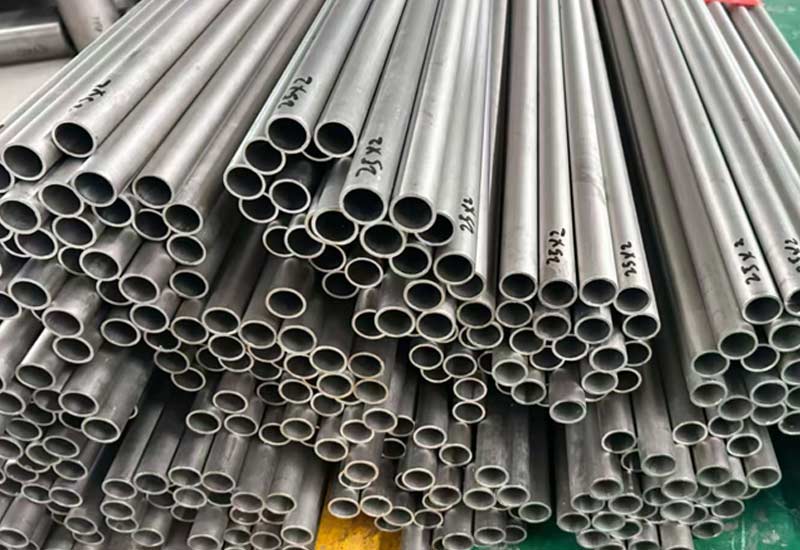
Seamless titanium tube and welded titanium tube describe different manufacturing routes. Neither label, on its own, establishes that the delivered product meets your equipment specification. ASTM B338 includes both routes within its scope.
Start with the approved design. If it requires seamless construction, preserve that requirement. If it permits welded tubing, evaluate the proposed product against the applicable manufacturing, condition and testing requirements rather than rejecting it solely because it contains a seam.
XFDY lists seamless and welded titanium tubing within its materials range. Confirm the available grade, dimensions, manufacturing route and required documentation for the particular order; a category listing is not confirmation of every possible combination.
When reviewing alternatives, ask suppliers to identify the exact route they are offering. Keep the diameter, wall requirement, length and inspection scope consistent across the comparison. Otherwise, the offers may differ in more than the seam.
The procurement decision should be an approved product specification, not a general preference for one manufacturing word over another.
4. Confusing Nominal Wall Thickness With Minimum Wall Thickness
A titanium tube wall thickness value needs a clearly stated acceptance basis. Is the number a nominal dimension with a permitted variation, or is it the minimum acceptable wall required by the design?
Those are different instructions.
Consider an illustrative purchasing example, not a published product tolerance. Suppose the parties agree to a nominal wall of 1.00 mm with a tolerance of ±0.10 mm. A measured wall of 0.90 mm falls within that dimensional range. It would not satisfy a separate requirement stating that the wall must be at least 1.00 mm.
Resolve that difference before requesting production. Have engineering establish the required wall, then ask the supplier to confirm the proposed nominal size and permitted variation against it. Do not independently add a wall allowance and assume it replaces the equipment design calculation.
Keep the Units and Acceptance Dimensions Explicit
Write outside diameter, wall thickness and length with their units and tolerances. Where the inside diameter also controls an interface, have the drawing define that requirement consistently rather than creating contradictory dimensions.
For a titanium tube order covering several sizes, keep each size on its own line. A note such as “same tolerance for all” should be deliberate and technically reviewed, not copied from the first item by default.
5. Buying Straight Tube Without Defining the Next Operation
The tube supplier and the fabricator may be quoting different endpoints. One may expect to deliver straight stock; the other may expect material ready for bending, welding or installation into a tubesheet.
Put that boundary in writing. A titanium tube order for straight lengths should not silently include finished U-bends, machined ends or a completed tube-to-tubesheet joint.
For a heat exchanger, ask the fabricator which incoming characteristics matter to the approved joining method. The review may need to address the tube ends, their fit in the tubesheet holes and the portion of the surface used by the joint. Identify the relevant drawing rather than leaving these details in an email attachment with no revision control.
Define the Finished Shape Before Requesting Bending
For titanium tube bending, provide the bend drawing and ask the fabricator to confirm the required radius, leg dimensions, permitted ovality and minimum wall in the formed section. Establish which measurements apply to the straight stock and which apply after forming.
If XFDY is being asked to provide more than straight material, use its custom titanium processing service to discuss the proposed scope. Confirm the particular forming or end-preparation requirements before treating them as included.
6. Accepting “Tested” Without Knowing What Was Tested
A titanium tube offer that says only “fully tested” leaves the receiving team with little to work from. Ask for the applicable test methods, acceptance requirements, coverage and reports—not simply a list of inspection equipment.
ASTM B338 addresses mechanical and integrity testing, with requirements that depend on the tubing route. Have the supplier identify the applicable requirements for the ordered product and any additional project requirements. Avoid turning one test method into a presumed substitute for the complete inspection package.
Separate three questions: whether the material meets its specified properties, whether the tube satisfies the required examination criteria, and whether the dimensions meet the drawing. Evidence answering one question does not automatically answer the other two.
A photograph of a weld is not a complete weld-quality assessment either. TWI’s guidance on titanium welding explains that surface appearance alone can be misleading, particularly where subsequent weld passes are involved. Use the agreed examination requirements for the product and fabrication process.
Before production starts, ask your quality team to review a sample report format. If third-party witnessing is required, settle the inspection stage and notification arrangements before that stage has passed.
7. Specifying Appearance but Leaving Cleanliness and Protection Open
“Bright finish” or “smooth surface” is not a complete delivery condition. Define the titanium tube surface finish that the next operation requires, and distinguish appearance from cleanliness and dimensional acceptance.
This matters when the tubing will be welded. TWI’s titanium weldability guidance identifies contamination as a source of welding problems and emphasizes clean working conditions, suitable tools and protection from steel particles. Its discussion of porosity in titanium welds also links moisture and surface condition to weld quality.
Translate the fabrication requirements into practical delivery instructions. Ask whether the internal surface needs a defined cleanliness condition, how prepared ends will be protected and what packaging materials may contact the tube. Do not assume that a capped tube has been cleaned to your process requirement.
For long lengths, agree how the shipment will be supported and restrained. Request packaging details suitable for the ordered dimensions and handling route, then check the tubes—not just the crates—at receiving.
Keep a distinction between factory preparation and final preparation immediately before welding. Transit protection supports the latter; it does not eliminate it.
8. Treating the Dispatch Date as the Entire Delivery Commitment
For a planned shutdown or a scheduled fabrication slot, “ready to ship” is only one milestone. Define when the material must arrive, when its documents must be available and what needs to happen before it can be released for use.
Ask the supplier to connect each titanium tube delivery lot with the material and inspection records required by the order. The identifiers on the documents and packaging should allow the receiving team to make that connection without relying on memory or an unrelated sample report.
Where an EN 10204 inspection document is required, specify the document type. BS EN 10204 defines types of inspection documents for metallic products and is used with the applicable technical delivery conditions. It is not a substitute for the product specification.
Request the document package early enough for review, and identify who can authorize release if questions arise. For split shipments, state the required quantities by size and delivery stage. One incomplete size line may matter more to the installation schedule than the total shipment weight.
Also agree how shortages, damaged pieces and specification deviations will be reported. Avoid making an undocumented substitution merely to preserve the original dispatch date.
Which Checks Should Your Team Resolve First?
Use the project constraint to set the review order. The following is a purchasing discussion aid, not a universal inspection plan or design standard.
| Purchasing situation | First discussion to resolve | Evidence to request |
|---|---|---|
| Retubing during a planned shutdown | Compatibility with the existing equipment and a usable delivery schedule | Approved replacement specification, quantities by length and document-review milestones |
| New heat exchanger fabrication | Required tube standard and the intended tube-to-tubesheet joining method | Tube specification and relevant interface drawings |
| Tubing that will be bent | Requirements for the finished formed section | Bend drawing, defined acceptance dimensions and proposed verification scope |
| A new or changed process fluid | Whether the approved material still fits the service conditions | Updated process data and engineering material approval |
| Switching to another supplier | Whether the proposed supply scope matches the existing requirement | A written response identifying conformance and any exceptions |
Resolve missing information with the relevant engineering or quality owner before asking suppliers to make assumptions. A complete RFQ does not need to be long, but it should make the product and acceptance requirements unambiguous.
For a deeper manufacturing-route comparison, see the guide to seamless and welded titanium tubes. Buyers preparing fittings and installation interfaces can also review the titanium pipe fittings selection guide.
Turn the Review Into a More Useful RFQ
Attach the approved titanium tube specification and the drawing for the item being purchased. Include the equipment interface drawing where it is needed for review, but distinguish it from the supplier’s manufacturing scope.
A useful inquiry could say:
We require titanium tubing for the heat exchanger project described in the attached specification. Please confirm the specified grade, product standard and edition, manufacturing route, dimensions and delivery condition. Identify any exceptions. Quote straight tube supply separately from any requested bending or end preparation, and describe the inspection records, packaging and delivery stages included.
For replacement tubing, explain what is being replaced and provide the existing approved documents. For a new design, label unresolved dimensions or material decisions as open items rather than presenting them as final requirements.
Ask suppliers to return a technically comparable response. “Available” is useful only when both parties mean the same material, geometry, condition and documentation package.
Conclusion
A titanium tube order should be ready for the next operation, not merely ready for shipment. Confirm the standard and service conditions first, then align the dimensions, fabrication scope, inspection and delivery requirements.
Planning a heat exchanger build or replacement-tube order? Send XFDY your tube specification and drawings, together with the quantity, required delivery date and documentation requirements. Ask for a review of the available supply options and any exceptions before releasing the order.
FAQ
What should a titanium tube purchase specification include?
Include the approved grade, product standard and edition, manufacturing route, delivery condition, outside diameter, wall requirement, length, tolerances, inspection, documentation, and packaging requirements.
Is seamless titanium tube always required for heat exchangers?
No. ASTM B338 includes seamless and welded tubing. The equipment design and project specification determine which manufacturing route is permitted.
Can titanium pipe be used instead of heat exchanger tube?
Not automatically. Pipe and heat exchanger tube standards have different product scopes. The responsible engineer should review dimensions, condition, testing, and service requirements before approving a substitution.
Why is minimum wall different from nominal wall thickness?
A nominal wall is a stated dimension with an applicable tolerance. A minimum wall requirement sets the lowest acceptable wall. Buyers should compare the smallest permitted wall with the design requirement.
What documents should be reviewed before shipment release?
Review the material evidence, dimensional reports, and test or examination records required by the order. Confirm that each document identifies the delivered lot before authorizing shipment.