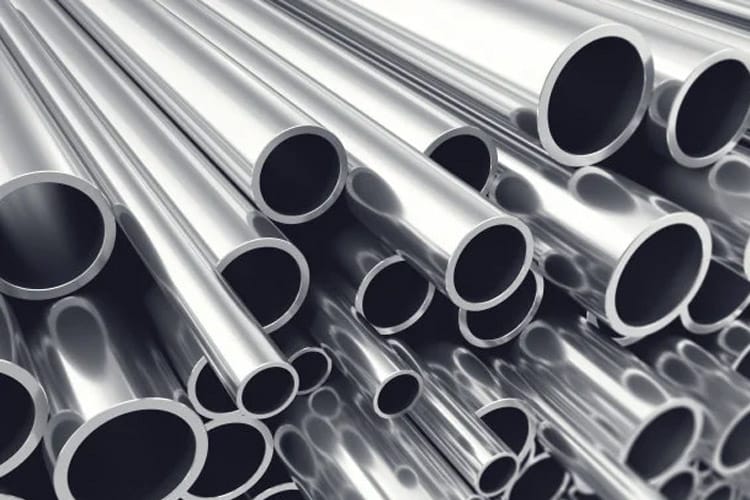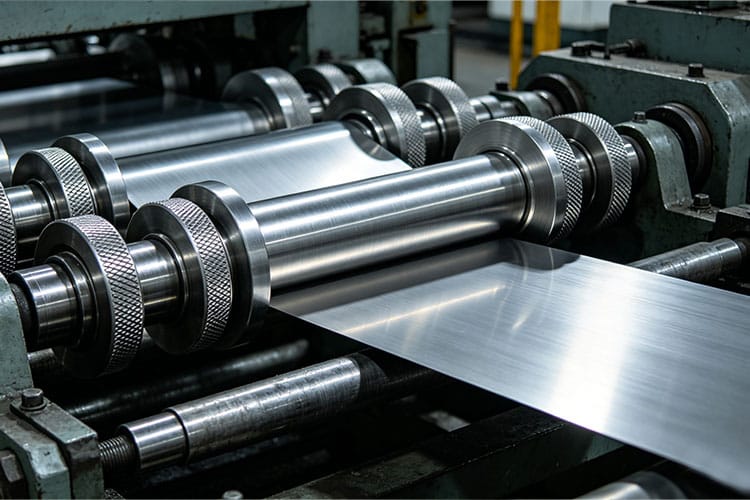
Titanium pipe fittings are used in piping systems where corrosion resistance, low weight, and reliable performance are important. They are found in chemical processing, marine systems, desalination, heat exchangers, power generation, and other specialized industrial applications.
Unlike standard steel fittings, titanium fittings are selected primarily for their ability to perform in demanding environments. However, choosing the right fitting involves more than simply specifying titanium.
The titanium grade, fitting type, dimensions, wall thickness, connection method, operating temperature, pressure, and service medium all need to be considered.
This guide explains the main types of titanium pipe fittings, where they are used, and what to consider when selecting them for an industrial piping system.
What Are Titanium Pipe Fittings?
Titanium pipe fittings are components used to connect, redirect, branch, or terminate titanium piping systems.
Depending on the system design, fittings can include:
- Elbows
- Tees
- Reducers
- Couplings
- Cross fittings
- Caps
- Adapters
- Custom-shaped fittings
Their primary purpose is to control the direction or configuration of a piping system while maintaining the required mechanical and corrosion performance.
Titanium fittings can be manufactured from commercially pure titanium or titanium alloys, depending on the application.
For corrosion-focused systems, commercially pure titanium such as Grade 2 may be appropriate in many applications. Where higher mechanical strength is required, titanium alloys such as Grade 5 may be considered.
The appropriate material should always be selected according to the actual service conditions and applicable specification.
Why Use Titanium Pipe Fittings?
Titanium is not normally selected for ordinary piping simply because it is a premium metal.
Its value comes from a combination of properties that can be particularly useful in demanding environments.
Corrosion Resistance
Titanium develops a stable protective oxide layer that provides strong resistance to corrosion in many environments.
This is one of the main reasons titanium piping components are considered for seawater, desalination, chemical processing, and other corrosive services.
However, corrosion performance depends on the specific environment. The chemical medium, concentration, temperature, velocity, contaminants, and other conditions should all be considered before selecting a grade.
Low Density
Titanium has a lower density than many commonly used engineering metals.
This can reduce the weight of piping components, which may be useful in offshore systems, marine equipment, transportation-related systems, and applications where installation weight matters.
Strength-to-Weight Performance
Some titanium alloys provide high strength relative to their weight.
This can make titanium fittings attractive when a system requires both mechanical performance and weight reduction.
Long-Term Performance
A corrosion-resistant fitting can help reduce maintenance requirements in difficult operating environments.
For systems where replacing a failed fitting requires significant labor or equipment downtime, material durability can be an important part of the purchasing decision.
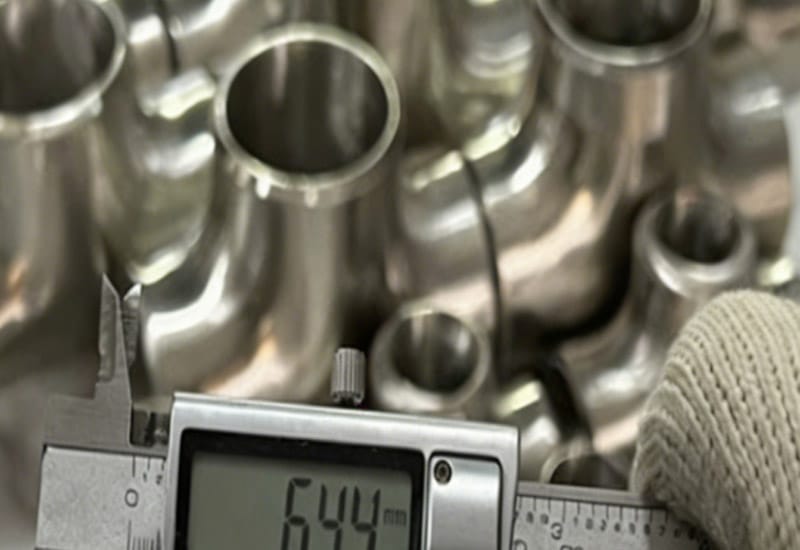
Common Types of Titanium Pipe Fittings
Different piping layouts require different fitting geometries.
The most common types include elbows, tees, reducers, couplings, and caps.
The correct fitting depends on the required flow direction, pipe dimensions, connection method, and system configuration.
Titanium Pipe Elbows
Titanium pipe elbows are among the most common titanium fittings.
An elbow changes the direction of the piping system without requiring a sharp bend in the pipe itself.
Common configurations include:
- 45-degree elbows
- 90-degree elbows
- 180-degree elbows
The appropriate angle depends on the piping layout and required flow direction.
Xinfeng Dingyuan supplies titanium pipe elbows in different configurations and material options for industrial piping applications.
45-Degree Titanium Elbows
A 45-degree elbow provides a relatively gradual change in flow direction.
It can be used when the piping layout requires a smaller directional change or when the system design benefits from a more gradual transition.
90-Degree Titanium Elbows
A 90-degree elbow is commonly used when a piping system needs to turn around a corner or change direction at a right angle.
Because 90-degree elbows are widely used across industrial piping systems, they are often one of the first titanium fitting configurations considered for custom or replacement applications.
180-Degree Titanium Elbows
A 180-degree elbow redirects flow back in the opposite direction.
These fittings can be useful in compact piping arrangements, return lines, and certain heat-transfer systems.
The appropriate radius and geometry depend on the piping design and applicable requirements.
Titanium Pipe Tees
A titanium tee is used when a piping system needs to branch into another line.
There are two common configurations:
Equal tee
The branch and main pipe have the same nominal size.
Reducing tee
The branch has a smaller diameter than the main pipe.
Titanium tees can be useful in chemical processing and other systems where the branch connection is exposed to the same corrosive environment as the main line.
Titanium Pipe Reducers
Reducers connect pipes with different diameters.
They can be designed as concentric or eccentric reducers depending on the system.
A concentric reducer maintains a common centerline, while an eccentric reducer shifts one side of the pipe.
The choice depends on the piping layout and fluid-handling requirements.
For titanium systems, the reducer material and wall thickness should be compatible with the connected pipes and operating conditions.
Titanium Couplings and Adapters
Couplings are used to join two pipe sections, while adapters allow connections between different pipe sizes, thread configurations, or connection standards.
For custom industrial systems, adapters can be particularly useful when existing equipment uses a different connection configuration from the new titanium piping.
The connection method should be defined clearly in the engineering drawing or purchase specification.
Titanium Pipe Caps
A titanium pipe cap closes the end of a pipe.
Caps may be used during system fabrication, equipment construction, temporary isolation, or permanent termination.
The required cap design depends on the pipe diameter, wall thickness, pressure, temperature, and connection method.
For pressure-containing systems, the cap should be designed and manufactured according to the applicable engineering standard.
Which Titanium Grades Are Used for Pipe Fittings?
Titanium pipe fittings can be manufactured from different grades depending on the required properties.
There is no single titanium grade that is best for every piping system.
| Titanium Grade | General Characteristics | Potential Applications |
|---|---|---|
| Grade 1 | High ductility and excellent corrosion resistance | Formed components and corrosion-sensitive applications |
| Grade 2 | Good balance of corrosion resistance and strength | Chemical, marine, and industrial piping |
| Grade 4 | Higher strength among commercially pure grades | More demanding industrial applications |
| Grade 5 | High-strength Ti-6Al-4V alloy | Weight-sensitive and mechanically demanding components |
| Grade 7 | Enhanced corrosion resistance in selected environments | Specialized chemical applications |
| Grade 9 | Moderate-strength titanium alloy with good formability | Tubing and selected industrial systems |
| Grade 12 | Good corrosion resistance with increased strength | Industrial and chemical processing |
The table provides a general starting point. The actual grade should be confirmed against the service environment and applicable specification.
For example, a chemically aggressive environment may require a different material assessment from a low-pressure seawater system.
Titanium Pipe vs Titanium Pipe Fittings
It is useful to distinguish the pipe itself from the fittings used to connect it.
Titanium pipe provides the main flow path.
Titanium fittings change the direction, diameter, or configuration of that flow path.
A complete titanium piping system may therefore contain:
Titanium pipe + elbows + tees + reducers + valves + flanges + other connections
All components need to work together.
Using corrosion-resistant titanium pipe with an unsuitable fitting material can create a weak point in the system.
Material compatibility should therefore be considered across the complete piping assembly.
Xinfeng Dingyuan also supplies titanium tubes and pipes, providing different titanium material forms for industrial applications.
Titanium Pipe Fittings for Chemical Processing
Chemical processing is one of the major application areas for corrosion-resistant titanium components.
Processing systems can expose piping and fittings to aggressive chemicals, elevated temperatures, pressure, and continuous fluid flow.
Titanium fittings may be considered for:
- Chemical processing pipelines
- Reaction systems
- Heat exchangers
- Storage and transfer systems
- Corrosive fluid handling
- Processing equipment
The chemical environment must be evaluated before selecting the titanium grade.
Important information includes:
- Chemical composition
- Concentration
- Temperature
- Pressure
- Flow velocity
- Oxygen conditions
- Contaminants
- Expected operating duration
This information allows the material selection to be based on actual service conditions rather than general assumptions.
Titanium Pipe Fittings for Marine Applications
Marine piping systems are exposed to moisture, salt, seawater, and chloride-containing environments.
Titanium can be attractive in these applications because of its corrosion resistance and relatively low density.
Potential applications include:
- Seawater piping
- Marine heat exchangers
- Desalination systems
- Offshore equipment
- Cooling systems
- Shipboard equipment
- Underwater systems
For seawater applications, the complete system should be evaluated, including pipes, fittings, valves, fasteners, and other connected components.
Galvanic compatibility is particularly important when titanium fittings are connected to other metals.
Titanium Pipe Fittings for Desalination
Desalination plants place demanding requirements on piping materials because seawater and concentrated brine can create challenging corrosion conditions.
Titanium can be used in selected desalination equipment, particularly in heat exchangers and seawater-handling systems.
Titanium fittings can support piping layouts around:
- Heat exchangers
- Pumps
- Seawater intake systems
- Brine systems
- Cooling systems
The material grade should be selected according to the specific water chemistry, temperature, flow conditions, and system design.
Titanium Pipe Fittings for Heat Exchangers
Heat exchangers can operate under a combination of elevated temperature, fluid pressure, and corrosive media.
Titanium is widely considered for heat-transfer applications where corrosion resistance is particularly important.
Pipe fittings around a heat exchanger may include elbows, reducers, tees, and other connection components.
The fitting must not only resist corrosion but also meet the mechanical and dimensional requirements of the system.
Temperature should therefore be included when selecting the material and wall thickness.
Titanium Pipe Fittings for Power Generation
Power-generation systems can include cooling water, condensers, heat exchangers, and other fluid-handling equipment.
In systems exposed to seawater or aggressive cooling media, titanium can provide an alternative to conventional materials where corrosion resistance is a major concern.
However, power-generation applications are typically specification-driven.
Buyers may require:
- Material certificates
- Chemical composition
- Mechanical test results
- Dimensional inspection
- Pressure testing
- Traceability
- Specific industry standards
These requirements should be agreed upon before manufacturing.
How to Choose the Right Titanium Pipe Fitting
Choosing a titanium pipe fitting should begin with the piping system rather than the fitting itself.
Confirm the Pipe Size
Start with the outside diameter, nominal pipe size, or other applicable dimensional standard.
A fitting cannot be correctly selected without knowing the dimensions of the pipe it must connect to.
Determine the Connection Type
The connection may involve:
- Butt welding
- Socket welding
- Threaded connection
- Flanged connection
- Custom connection
Welding is common in many industrial titanium piping systems, while flanged or other connections may be preferred where disassembly is required.
Identify the Operating Pressure
Pressure affects wall thickness, fitting geometry, and the required manufacturing specification.
For pressure-containing systems, do not select a fitting based solely on nominal pipe diameter.
Check the Operating Temperature
Temperature can affect mechanical properties and corrosion behavior.
The fitting should be evaluated across the expected operating temperature range rather than only at room temperature.
Identify the Service Medium
Water, seawater, acids, alkalis, process chemicals, gases, and other media can produce very different material requirements.
Always provide the actual service medium to the manufacturer.
Specify the Titanium Grade
If the project already specifies a titanium grade, include it in the purchase specification.
If the grade has not yet been finalized, provide the service conditions so the manufacturer or materials engineer can evaluate suitable options.
Confirm the Applicable Standard
Different product forms and applications may be covered by different ASTM, ASME, ISO, or customer specifications.
For example, ASTM B861 covers seamless titanium and titanium alloy pipe for corrosion-resistant and elevated-temperature service. ASTM B861
For titanium and titanium alloy forgings, ASTM B381 provides requirements for specified grades and forging products. ASTM B381
The exact standard should be confirmed according to the product and application.
Titanium Pipe Fittings vs Stainless Steel Pipe Fittings
Stainless steel is widely used for industrial piping, so it is a common alternative to titanium.
The comparison should be based on the specific grades and service conditions.
| Factor | Titanium Pipe Fittings | Stainless Steel Pipe Fittings |
|---|---|---|
| Density | Lower | Higher |
| Corrosion resistance | Excellent in many environments | Varies by grade |
| Marine service | Highly suitable for selected systems | Grade dependent |
| Material cost | Higher | Generally lower |
| Availability | More specialized | Broad |
| Weight-sensitive systems | Advantage | Less advantageous |
| Chemical processing | Suitable for selected environments | Grade dependent |
| Machining/forming | More specialized | Generally easier |
For a standard industrial water line, stainless steel may provide better overall economics.
For a seawater system where corrosion resistance and long-term service are critical, titanium may justify its higher initial cost.
The decision should be based on lifecycle requirements rather than purchase price alone.
What Dimensions Should Be Specified?
A titanium pipe fitting should be specified with enough dimensional information to ensure it matches the piping system.
Depending on the fitting, this may include:
- Nominal pipe size
- Outside diameter
- Wall thickness
- Center-to-end dimension
- Elbow radius
- Overall length
- Branch diameter
- Connection dimensions
- Flange dimensions
- Thread specification
- Tolerances
For a standard fitting, an applicable dimensional standard may provide much of this information.
For a custom fitting, an engineering drawing is strongly recommended.
Custom Titanium Pipe Fittings
Standard fittings do not always meet the requirements of specialized equipment.
Custom titanium fittings can be manufactured when a project requires:
- Non-standard dimensions
- Special elbow angles
- Custom wall thickness
- Unusual connection geometry
- Specific titanium grades
- Special tolerances
- Integration with existing equipment
For example, a custom titanium elbow may need a non-standard angle or center-to-end dimension to fit an existing piping system.
Custom manufacturing can also be useful when replacement components are no longer commercially available.
A drawing, CAD model, or physical sample can help the manufacturer determine the appropriate production process.
How Are Titanium Pipe Fittings Manufactured?
The manufacturing method depends on the fitting geometry, material grade, dimensions, and required production volume.
Possible processes include:
Cutting
Titanium tube, pipe, plate, or other stock is prepared for forming or machining.
Forming
Suitable fittings may be formed into the required geometry using controlled manufacturing processes.
Forging
Forging may be used for suitable fitting designs where controlled deformation and mechanical performance are important.
CNC Machining
Machining can produce accurate connection surfaces, dimensions, holes, and custom features.
Welding
For welded fittings and piping assemblies, controlled welding procedures are required because titanium is sensitive to contamination during welding.
Finishing and Inspection
The finished fitting may undergo dimensional inspection, surface treatment, testing, and documentation according to the project requirements.
The manufacturing route should be determined from the actual design rather than from the fitting name alone.
Why Titanium Welding Requires Special Attention
Titanium reacts strongly with atmospheric gases at elevated temperatures.
During welding, adequate shielding is therefore critical.
The weld area and surrounding heated titanium need appropriate protection from oxygen, nitrogen, and other contaminants.
Poor shielding can result in discoloration, contamination, and reduced weld quality.
For industrial titanium piping, welding procedures should be established according to the applicable specification and the material being joined.
This is especially important for pressure-containing systems and critical service environments.
How to Order Titanium Pipe Fittings
A complete inquiry makes it easier for a manufacturer to provide an accurate quotation.
Ideally, provide:
| Information | What to Specify |
|---|---|
| Fitting type | Elbow, tee, reducer, cap, etc. |
| Material | Titanium grade |
| Pipe size | OD or nominal size |
| Wall thickness | Required thickness |
| Angle | 45°, 90°, 180°, or custom |
| Radius | Short radius, long radius, or custom |
| Connection | Welded, threaded, flanged, etc. |
| Quantity | Required number of pieces |
| Operating pressure | System pressure |
| Operating temperature | Service temperature |
| Medium | Water, seawater, chemical, gas, etc. |
| Standard | ASTM, ASME, ISO, or customer specification |
| Inspection | Required testing or certification |
| Drawing | Recommended for custom fittings |
Providing this information at the beginning of the quotation process can reduce misunderstandings and unnecessary revisions.
How to Reduce the Cost of Titanium Pipe Fittings
Titanium is more expensive than many conventional piping materials, so cost control matters.
However, reducing cost does not mean choosing the cheapest available fitting.
Instead, consider the complete lifecycle.
Choose the Correct Grade
Using a specialized titanium alloy where commercially pure titanium would meet the requirements may add unnecessary cost.
At the same time, using a lower-grade material that cannot withstand the service environment can lead to premature failure.
Avoid Unnecessary Customization
If a standard titanium fitting meets the design requirements, it will often be more economical than developing a completely custom geometry.
Optimize Dimensions
Excessively tight tolerances or unnecessary wall thickness can increase manufacturing costs.
Dimensions should be based on engineering requirements.
Consider the Manufacturing Route
For larger quantities, a forming or forging process may reduce machining requirements.
For small quantities, CNC machining may be more practical because dedicated tooling may not be justified.
Provide Complete Specifications
A clear drawing and complete technical requirements help the manufacturer quote the correct product the first time.
This can reduce revisions, production delays, and unexpected costs.
What Makes a Good Titanium Pipe Fitting Supplier?
Price is important, but it should not be the only consideration when selecting a supplier.
For industrial titanium fittings, evaluate:
- Material grade capability
- Manufacturing experience
- Product dimensions
- Customization capability
- Quality control
- Inspection procedures
- Material traceability
- Applicable certifications
- Production capacity
- Lead time
- Packaging
- Technical communication
For custom projects, the supplier should also be able to understand engineering drawings and discuss the relationship between material, geometry, manufacturing process, and final application.
Final Thoughts
Titanium pipe fittings are designed for piping systems where corrosion resistance, weight, mechanical performance, or long-term durability justify the use of titanium.
The right fitting is determined by much more than its shape.
Before purchasing, define the fitting type, pipe dimensions, titanium grade, connection method, operating pressure, temperature, service medium, applicable standards, and inspection requirements.
For standard systems, commercially available elbows, tees, reducers, and other fittings may provide a straightforward solution. For specialized equipment, custom titanium fittings can be manufactured according to drawings, samples, and technical specifications.
The most effective approach is to select the titanium material and fitting design together with the actual operating conditions in mind.
If your project requires titanium pipe elbows, tubes, custom fittings, or other titanium components, providing complete technical information at the quotation stage can help the manufacturer recommend an appropriate material and manufacturing route.
Frequently Asked Questions
What are titanium pipe fittings used for?
Titanium pipe fittings are used in chemical processing, marine systems, desalination, heat exchangers, power generation, and other applications where corrosion resistance and reliable performance are important.
What is the most common titanium pipe fitting?
Elbows are among the most commonly used titanium pipe fittings. Typical configurations include 45-degree, 90-degree, and 180-degree elbows.
What titanium grade is commonly used for pipe fittings?
Grade 2 is commonly considered for many corrosion-resistant industrial applications, while other grades may be selected according to strength, corrosion environment, temperature, and applicable specifications.
Are titanium pipe fittings better than stainless steel?
Not in every application. Titanium can provide advantages in demanding corrosive environments and weight-sensitive systems, while stainless steel is often more economical and readily available.
Can titanium pipe fittings be customized?
Yes. Custom titanium fittings can be manufactured according to drawings, CAD files, samples, dimensions, angles, connection requirements, and material specifications.
Can titanium pipe fittings be welded?
Yes. Titanium fittings can be welded, but proper shielding and controlled welding procedures are important to prevent contamination and maintain weld quality.
What information is needed to order titanium pipe fittings?
Provide the fitting type, titanium grade, pipe size, wall thickness, dimensions, connection method, quantity, operating pressure and temperature, service medium, applicable standards, and drawing if available.