Titanium bolts and stainless steel bolts can both provide reliable fastening, but they are not interchangeable in every application.
The choice becomes particularly important when weight, corrosion resistance, strength-to-weight ratio, temperature, or long-term durability matters. Titanium fasteners can offer significant performance advantages in demanding environments, while stainless steel remains a practical choice for many general-purpose applications because of its availability and lower cost.
So which should you choose?
The answer depends on the application, load requirements, environment, installation conditions, and overall project budget.
This guide compares titanium bolts and stainless steel bolts to help engineers, designers, and purchasing teams make a more informed fastener selection.
Table of Contents
Titanium Bolts vs Stainless Steel Bolts at a Glance
The most important difference is not simply strength.
Titanium provides a combination of relatively low density, high strength-to-weight performance, and excellent corrosion resistance. Stainless steel, on the other hand, offers a broad range of grades, good mechanical performance, easier availability, and generally lower material cost.
| Factor | Titanium Bolts | Stainless Steel Bolts |
|---|---|---|
| Weight | Lower | Higher |
| Strength-to-weight ratio | Excellent | Good to very good |
| Corrosion resistance | Excellent for many demanding environments | Excellent, depending on grade |
| Material cost | Generally higher | Generally lower |
| Availability | More specialized | Widely available |
| Machining | More demanding | Generally easier |
| Marine applications | Excellent for selected applications | Grade dependent |
| Aerospace applications | Strong advantage where weight matters | More limited in weight-sensitive designs |
| General industrial use | Suitable for demanding applications | Suitable for many standard applications |
| Custom manufacturing | Available | Widely available |
The right choice depends on what the fastener needs to do rather than which material appears stronger on paper.
What Are Titanium Bolts?
Titanium bolts are threaded fasteners manufactured from commercially pure titanium or titanium alloys.
Different grades provide different combinations of strength, ductility, corrosion resistance, and machinability.
Grade 2 titanium may be considered when corrosion resistance and formability are important, while Grade 5 Ti-6Al-4V is widely used when higher strength and strength-to-weight performance are required.
Titanium bolts can be manufactured in different head styles, thread sizes, lengths, and configurations.
They may be used in applications such as:
- Aerospace equipment
- Marine systems
- Chemical processing equipment
- Medical and specialized equipment
- Racing and performance applications
- Outdoor equipment
- Industrial machinery
- Weight-sensitive assemblies
For custom requirements, titanium fasteners can also be produced according to drawings, specifications, or customer-defined dimensions.
What Are Stainless Steel Bolts?
Stainless steel bolts are fasteners manufactured from corrosion-resistant stainless steel alloys.
Unlike titanium, stainless steel covers a large family of materials with different compositions and properties.
Common stainless steel fastener materials include grades such as 304 and 316, although the appropriate specification depends on the application and required performance.
Stainless steel bolts are widely used because they offer:
- Good corrosion resistance
- Good mechanical strength
- Wide material availability
- Standardized dimensions
- Broad supplier availability
- Competitive pricing
- Many head and thread configurations
For general industrial, construction, machinery, and equipment applications, stainless steel is often a practical starting point.
Weight: Titanium Has a Clear Advantage
Weight is one of the easiest differences to understand.
Titanium has a lower density than stainless steel, meaning a titanium bolt of comparable dimensions weighs significantly less.
This can become important when hundreds or thousands of fasteners are used in a single assembly.
Consider a structure containing several hundred bolts. Reducing the weight of each fastener by even a few grams may produce a meaningful total reduction.
This is particularly relevant in:
- Aerospace
- Racing
- Performance bicycles
- Robotics
- Portable equipment
- Weight-sensitive machinery
- Specialized transportation systems
For applications where weight has little impact on system performance, the benefit may not justify titanium’s higher cost.
But when every kilogram matters, titanium becomes much more attractive.
Strength-to-Weight Ratio
Looking only at tensile strength can make stainless steel and titanium appear more similar than they actually are.
A more useful metric for weight-sensitive designs is strength-to-weight ratio.
Titanium alloys such as Grade 5 Ti-6Al-4V provide high strength while maintaining relatively low density.
This means a designer may be able to achieve the required fastening performance with significantly less weight than an equivalent stainless steel fastener.
This is one of the main reasons titanium fasteners are used in high-performance applications.
However, the exact strength depends on the titanium grade, product condition, diameter, thread configuration, heat treatment where applicable, and relevant specification.
Fastener selection should therefore be based on the actual mechanical requirements rather than a generic comparison between “titanium” and “stainless steel.”
Corrosion Resistance
Both materials can provide excellent corrosion resistance, but the way they perform depends on the environment and material grade.
Titanium develops a stable oxide layer that provides strong protection against many corrosive environments.
This makes titanium attractive for marine, seawater, chemical, and other demanding applications.
Stainless steel also provides corrosion resistance through its chromium-rich passive surface layer. However, the level of corrosion resistance varies significantly between stainless steel grades.
For example, 316 stainless steel is generally more resistant to chloride-containing environments than 304 stainless steel.
Therefore, when comparing materials for marine or chemical applications, the comparison should be:
Specific titanium grade vs specific stainless steel grade
rather than simply:
Titanium vs stainless steel
Titanium Bolts for Marine Applications
Marine environments can be particularly demanding because fasteners may be exposed to seawater, salt spray, humidity, and chloride-containing conditions.
Titanium can be an attractive option when long-term corrosion resistance and low weight are important.
Potential applications include:
- Marine equipment
- Boat components
- Underwater equipment
- Seawater systems
- Desalination equipment
- Marine heat exchangers
- Specialized marine structures
Titanium fasteners can also be useful when galvanic corrosion needs to be considered.
However, galvanic compatibility depends on the materials that the titanium fastener contacts, the electrolyte, surface conditions, and the overall assembly design.
The fastener material should therefore be evaluated as part of the complete system rather than in isolation.
Titanium Bolts for Aerospace Applications
Aerospace applications place significant emphasis on weight, mechanical performance, reliability, and material consistency.
A reduction in fastener weight can become valuable when large numbers of fasteners are used throughout an aircraft or aerospace assembly.
Titanium alloys can provide a useful combination of strength and low density, making titanium fasteners attractive for selected aerospace applications.
However, aerospace fasteners are specification-driven.
A suitable aerospace titanium bolt may require specific:
- Material grade
- Mechanical properties
- Thread specification
- Dimensional tolerances
- Surface treatment
- Testing
- Certification
- Traceability
A standard commercial titanium bolt should not automatically be treated as an aerospace-qualified fastener.
The required aerospace specification must be confirmed before production.
Titanium Bolts for Chemical and Industrial Equipment
Chemical-processing equipment can expose fasteners to aggressive chemicals, moisture, temperature variations, and other demanding conditions.
Titanium’s corrosion resistance makes it worth considering for selected chemical and industrial applications.
Titanium fasteners may be used around:
- Chemical tanks
- Piping systems
- Heat exchangers
- Pumps
- Processing equipment
- Corrosion-resistant structures
The specific chemical environment remains critical.
Before selecting titanium bolts, provide information about the chemical medium, concentration, operating temperature, pressure, and expected service life.
A material recommendation based only on the word “chemical” is not sufficient.
Titanium vs Stainless Steel: Which Is Stronger?
There is no universal answer because both titanium and stainless steel represent multiple material grades.
Grade 5 titanium, for example, has very different mechanical properties from commercially pure Grade 2 titanium.
Likewise, 304 stainless steel and high-strength stainless steel fastener grades cannot be treated as the same material.
For a fastener application, engineers should evaluate:
- Tensile strength
- Yield strength
- Shear strength
- Fatigue performance
- Hardness
- Thread strength
- Preload requirements
- Operating temperature
The bolt diameter and thread geometry also have a major influence on the actual load capacity.
In other words, material selection is only one part of fastener design.
Titanium Bolts vs Stainless Steel Bolts for High-Temperature Applications
Temperature can change the suitability of both materials.
A bolt exposed to elevated temperature may experience changes in strength, creep behavior, oxidation, and dimensional stability.
The appropriate material therefore depends on the actual operating temperature and duration.
Titanium alloys can be useful across a range of demanding environments, but they are not automatically the best option for every high-temperature application.
For significantly elevated temperatures, engineers should check the relevant material data and design specifications before selecting a titanium or stainless steel fastener.
Thread Design Matters
A bolt is not defined by material alone.
Thread design has a direct effect on installation, load transfer, friction, and resistance to stripping.
Titanium’s lower hardness compared with some hardened steel materials means that thread design and installation practices deserve particular attention.
Factors to consider include:
- Thread size
- Thread pitch
- Thread engagement
- Nut material
- Surface condition
- Lubrication
- Installation torque
- Preload
- Repeated assembly
For critical assemblies, the complete bolt-and-nut combination should be evaluated rather than selecting the bolt independently.
Titanium Fasteners and Galling
Galling is an important consideration when installing titanium fasteners.
Galling occurs when contacting surfaces experience adhesion and material transfer under pressure and relative movement. Titanium fasteners can be susceptible to this problem, particularly when titanium threads contact titanium threads under high installation loads.
This can cause:
- Thread damage
- Increased installation resistance
- Fastener seizure
- Difficulty during disassembly
- Damaged nuts or bolts
Proper installation practices can reduce the risk.
Depending on the application, engineers may consider appropriate lubrication, compatible mating materials, controlled installation torque, and suitable surface treatments.
This is especially important when titanium fasteners need to be repeatedly installed and removed.
Are Titanium Bolts Worth the Higher Cost?
Titanium bolts generally cost more than standard stainless steel bolts.
The higher price comes from factors including material cost, manufacturing complexity, machining requirements, and more specialized supply chains.
The key question is therefore not:
“Are titanium bolts expensive?”
It is:
“Does the application benefit enough from titanium to justify the additional cost?”
Titanium can be worth the investment when the fastener provides an important functional advantage.
For example, a higher-cost titanium bolt may make sense when it:
- Reduces system weight
- Improves corrosion resistance
- Extends service life
- Performs in a demanding marine environment
- Meets a specialized engineering requirement
- Simplifies weight-sensitive designs
For a standard indoor machine where weight and corrosion are not major concerns, stainless steel may provide better overall value.
When Stainless Steel Is the Better Choice
Titanium is not automatically the better fastener.
Stainless steel may be the more practical option when:
- Cost is the primary concern
- Weight reduction has little value
- Standard sizes are required immediately
- Large quantities are needed
- The operating environment is moderate
- Standard stainless steel grades already meet the performance requirements
Stainless steel also has a much broader range of standard fastener products available from distributors and hardware suppliers.
For many general-purpose applications, that availability can outweigh the performance benefits of titanium.
When Titanium Bolts Are the Better Choice
Titanium becomes more attractive when the application has specific performance requirements that stainless steel cannot meet as efficiently.
Consider titanium when:
Weight is critical
Aerospace, racing, bicycle, robotics, and other weight-sensitive applications can benefit from lower-density fasteners.
Corrosion resistance is demanding
Marine, seawater, chemical, and outdoor applications may benefit from titanium’s corrosion resistance.
Strength-to-weight performance matters
Grade 5 titanium can provide a strong combination of mechanical performance and relatively low weight.
Long service life matters
Replacing corroded or damaged fasteners in difficult-to-access locations can be expensive, making long-term durability important.
The part is highly specialized
Custom titanium fasteners can be manufactured to specific dimensions, thread requirements, and application conditions.
Titanium Bolt Grades: Which One Should You Choose?
The appropriate titanium bolt grade depends on the required performance.
Grade 2 Titanium Bolts
Grade 2 is commercially pure titanium and is often considered when corrosion resistance, ductility, and formability are important.
It can be relevant for selected industrial, chemical, and marine applications.
Grade 5 Titanium Bolts
Grade 5 titanium, or Ti-6Al-4V, provides significantly higher strength than commercially pure titanium.
It is commonly considered for high-performance fasteners where strength-to-weight performance is important.
Other Titanium Grades
Other titanium grades may be appropriate for specialized environments or applications.
The correct choice should be based on the applicable material and fastener specification rather than assuming that Grade 5 is suitable for every application.
Standard Titanium Bolts vs Custom Titanium Bolts
Standard titanium bolts are suitable when common dimensions and thread specifications meet the project requirements.
Custom titanium bolts become useful when the fastener needs a specific:
- Diameter
- Length
- Thread
- Head style
- Drive type
- Material grade
- Surface finish
- Dimensional tolerance
Custom manufacturing can also be useful when the bolt needs to match a specialized assembly or replace an unusual existing fastener.
Xinfeng Dingyuan provides custom titanium bolts in different dimensions and configurations for specialized applications.
When requesting a custom titanium bolt, providing a drawing or complete technical specification can significantly improve quotation accuracy.
What Information Should You Provide When Ordering Titanium Bolts?
A supplier needs more than the bolt diameter to produce the correct fastener.
Ideally, provide:
| Requirement | Example Information |
|---|---|
| Material | Grade 2, Grade 5, etc. |
| Diameter | M6, M10, M20, etc. |
| Length | Overall or threaded length |
| Thread | Metric, UNC, UNF, or other specification |
| Head style | Hex, socket head, countersunk, etc. |
| Drive | Hex socket, Torx, external hex, etc. |
| Quantity | Required production volume |
| Surface | As-machined, polished, coated, etc. |
| Standard | ASTM, ISO, DIN, customer specification |
| Application | Marine, aerospace, industrial, medical, etc. |
| Drawing | Recommended for custom products |
For critical applications, also provide required mechanical properties, inspection requirements, certificates, and traceability requirements.
How Are Custom Titanium Bolts Manufactured?
The manufacturing route depends on the bolt design, titanium grade, dimensions, tolerance requirements, and production quantity.
A simplified process may include:
Material selection → cutting → turning → threading → head machining or forming → finishing → inspection → packaging
For certain designs and production volumes, forging may also be incorporated into the manufacturing process.
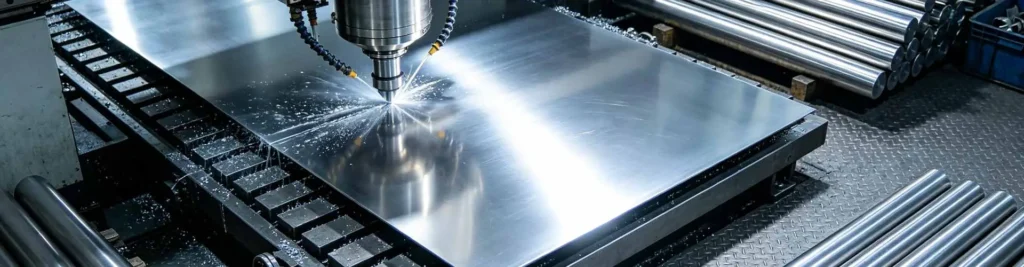
CNC machining can be used to produce precise bolt dimensions, threads, head configurations, and other custom features.
The appropriate manufacturing route should be determined after reviewing the engineering drawing.
Titanium Bolts for Specialized Applications
Titanium fasteners are not limited to aerospace and marine applications.
They can also be considered for:
- Performance bicycles
- Racing equipment
- Outdoor equipment
- Robotics
- Specialized machinery
- Medical equipment
- Chemical processing systems
- Laboratory equipment
- Corrosion-sensitive assemblies
The common factor is that the application has a reason to justify titanium’s performance or weight advantage.
Using titanium simply because it is a premium material does not necessarily create a better engineering solution.
How to Choose Between Titanium and Stainless Steel Bolts
A practical selection process can be simplified into five questions.
Does weight matter?
If yes, titanium deserves serious consideration.
Is the environment highly corrosive?
If yes, compare suitable titanium and stainless steel grades against the actual environment.
Does the application require high strength-to-weight performance?
If yes, high-strength titanium alloys such as Grade 5 may be relevant.
Is the additional material cost justified?
If titanium provides a functional advantage that affects the performance or service life of the assembly, the higher initial cost may be justified.
Are standard stainless steel fasteners already sufficient?
If yes, stainless steel may be the more economical and practical choice.
This approach keeps the decision focused on engineering requirements rather than material preference.
Final Thoughts
Titanium bolts and stainless steel bolts both have their place in engineering.
Stainless steel is often the practical choice for general-purpose fastening because it offers good corrosion resistance, broad availability, and lower cost.
Titanium becomes more attractive when the application requires lower weight, excellent corrosion resistance, high strength-to-weight performance, or a specialized fastener solution.
The best material depends on the complete application.
Before ordering, evaluate the operating environment, required mechanical properties, bolt dimensions, thread design, installation conditions, production quantity, applicable standards, and total cost.
For standard applications, stainless steel may be all that is needed. For demanding or weight-sensitive applications, titanium bolts can provide advantages that justify the additional investment.
If your project requires custom titanium bolts, provide the material grade, dimensions, thread specification, quantity, application requirements, and engineering drawing whenever possible. This allows the manufacturer to evaluate the most appropriate material and production process for the finished fastener.
FAQ
Are titanium bolts stronger than stainless steel bolts?
It depends on the specific grades being compared. Grade 5 titanium provides high strength with a lower density than many stainless steels, giving it an excellent strength-to-weight ratio.
Are titanium bolts better for marine applications?
Titanium can be an excellent choice for selected marine applications because of its corrosion resistance and low density. The specific titanium and mating materials should still be evaluated for the actual environment.
Why are titanium bolts more expensive?
Titanium material is generally more expensive than stainless steel, and titanium fasteners can require more specialized machining and manufacturing processes.
Do titanium bolts rust?
Titanium does not rust in the same way as ordinary iron or carbon steel. Its stable oxide layer provides strong corrosion protection in many environments.
Are titanium bolts suitable for aerospace applications?
Titanium fasteners are used in selected aerospace applications, particularly where weight and strength-to-weight performance are important. Aerospace projects require the appropriate material and fastener specifications.
What is the most common titanium bolt grade?
Grade 5 Ti-6Al-4V is a widely used high-strength titanium alloy for fasteners and other components, while commercially pure grades such as Grade 2 are also used for applications where corrosion resistance and formability are important.
Can titanium bolts be custom made?
Yes. Titanium bolts can be manufactured with custom diameters, lengths, thread configurations, head styles, tolerances, and material grades according to engineering drawings or specifications.